The Beginner's Classic Tavern Boule
Four ingredients, thirty-six hours, one unforgettable loaf. This is the recipe we give every friend who asks, "Where should I start?" It's forgiving, repeatable, and the crust is genuinely thrilling.
Instructions
-
Build the levain (night before, ~9 PM)
Mix 30 g starter, 60 g flour, and 60 g water in a jar. Cover loosely and leave at room temperature overnight. By morning it should be domed, bubbly, and smell sweet-tangy.
-
Autolyse (morning, ~9 AM)
In a large bowl, mix 400 g bread flour, 100 g whole wheat (all purpose flour is just fine, so 500g all purpose flour instead), and 350 g of the water (hold back 25 g). Mix until just combined — shaggy is fine. Cover and rest 30–45 minutes. This hydrates the flour and starts gluten development without any kneading.
-
Mix in levain & salt (~9:45 AM)
Add 120 g of your active levain, the reserved 25 g water, and 10 g salt. Pinch and fold the dough to incorporate — use wet hands. Aim for a smooth, cohesive mass. This takes about 3 minutes.
-
Bulk ferment with folds (~10 AM – 2 PM)
Over the next four hours, perform four sets of stretch-and-folds, 30 minutes apart. Pull your dough gently and fold it back onto itself, feeling the fibers stretch with each pull. Do not pull too hard and rip the dough, strength will build over time. After the folds, let the dough rest undisturbed until it's jiggly, domed, and roughly 50% larger. Temperature matters — aim for a 68–75°F spot. Remember, colder temps ferment slower, warmer temps ferment faster.
-
Preshape & bench rest (~2 PM)
Turn the dough onto an unfloured counter. With a bench scraper, shape it into a loose round. You might notice gas bubbles forming — this is a good sign. Place an inverted bowl over it to retain moisture. Let it rest 30 minutes, — this relaxes the gluten and makes final shaping easier.
-
Final shape & cold retard (~2:30 PM)
Shape firmly into a tight ball. Place seam-up in a floured banneton. Cover and refrigerate overnight, ideally 12–16 hours. The cold develops flavor and makes scoring dramatically easier.
-
Bake (next morning)
Preheat oven with Dutch oven inside to 475°F for at least 45 minutes (Not every oven is created equal, be sure to check your oven's calibration, a reliable oven thermometer can be found in any grocery store for under $10). If you dont own a dutch oven you can use a regular baking sheet(If you use the baking sheet, place it on the middle rack and add a pan of water to create steam, if you do, remember to remove the pan of water after 20 minutes). Turn the cold dough onto parchment, score confidently with a single deep slash about 1/2 inch deep or a simple cross. Transfer to the Dutch oven, cover.
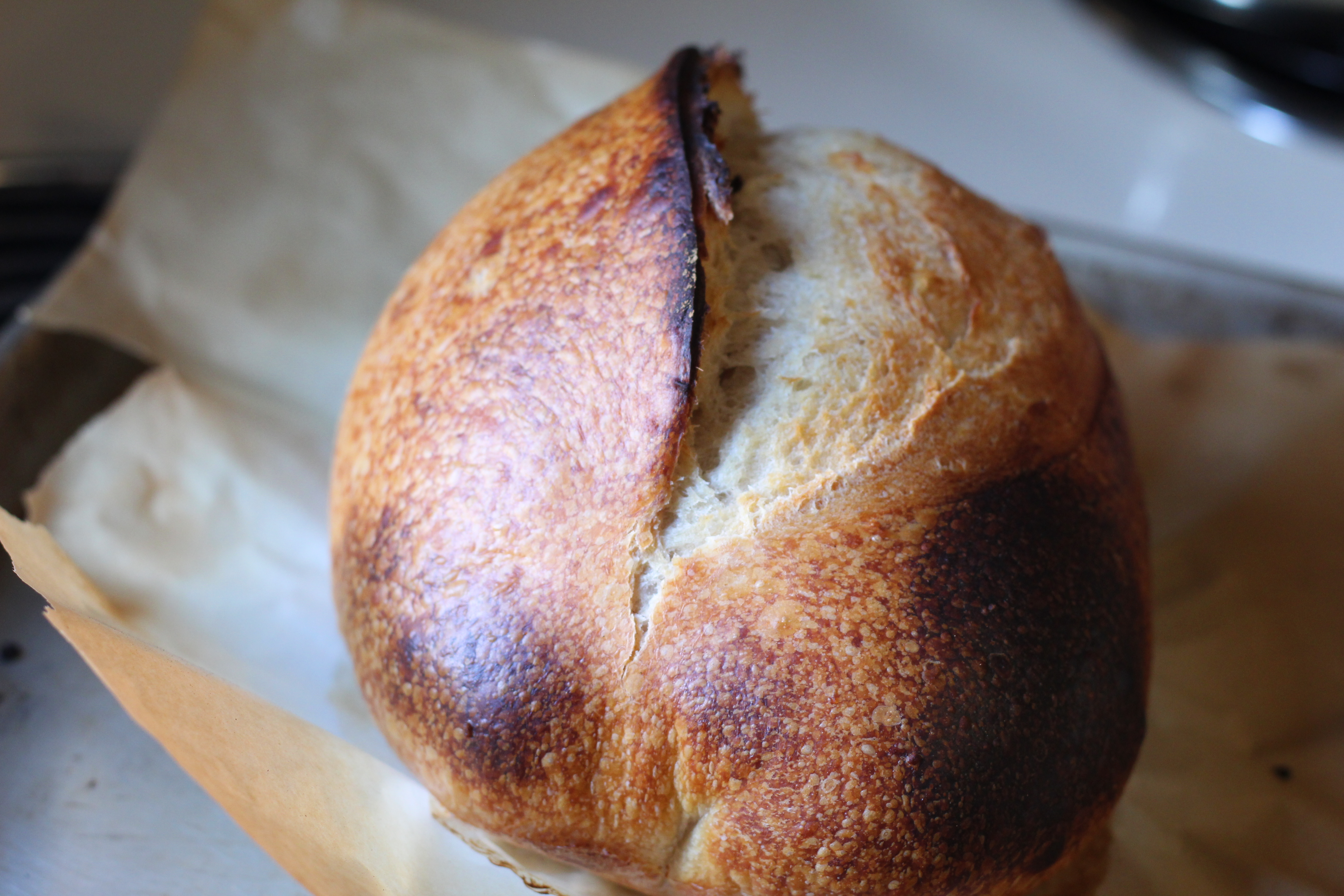
Bake covered 20 minutes at 475°F. Remove the lid, reduce to 450°F, and bake another 20–25 minutes until deeply golden brown — almost mahogany. Internal temp should read 205–210°F.
-
Cool (the hardest step)
Transfer to a wire rack. Let it cool at least one full hour, preferably two before cutting — the crumb is still setting up inside. We know it's hard. Do not cut it yet.
Your first loaf won't look like the photo — and that's okay. Sourdough rewards repetition. By loaf three or four, your hands will know what the dough is telling you. Keep notes, and trust the process.
Dense crumb? Under-fermented. Let bulk go longer, or warm up your space. Flat loaf? Over-fermented, or shaping needs more tension. Pale crust? Bake longer, your sourdough wants color.
Enjoyed this recipe?
Get a new recipe and baker's notes from the kitchen every Thursday. No spam — just bread.